Connected Services
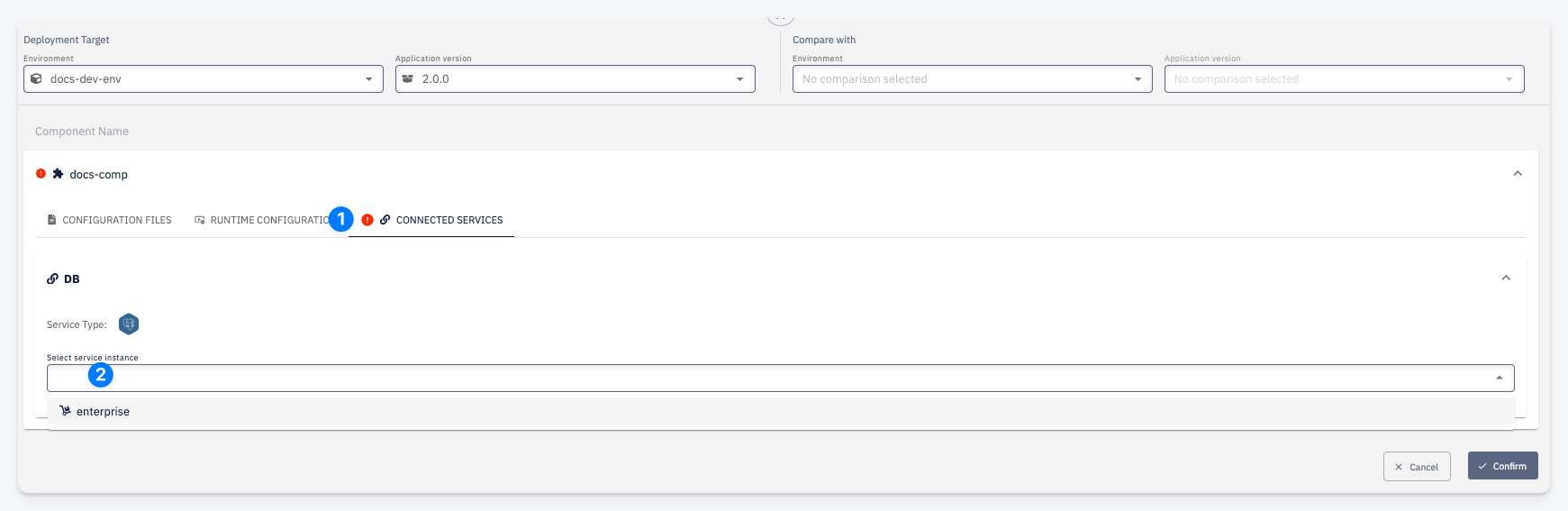
The Connected Services section lists all service bindings declared in the component. For each binding, select the specific service instance to use in this environment.
| # | Element | Description |
|---|---|---|
| 1 | Binding name | The name of the connected service binding as declared in the component, along with the service type icon |
| 2 | Select service instance | Choose the Hosted Service or Connected Service instance to connect in this environment. The instance picker only offers instances that are available in this environment |
A binding declares a dependency on a Service Template, not on "hosted" or "connected" specifically — so the instance picker offers any matching Hosted or Connected Service instance, and you're free to choose differently per environment. For example, the db binding could be fulfilled by a Hosted Service instance that CodeNOW provisions and runs in dev, and by a Connected Service instance pointing at a shared database in prod.
Every binding must have an instance assigned. If any binding is left unset, the configuration cannot be saved and the application cannot be deployed to this environment.
Variable naming
Each binding you connect here is exposed to the component as one or more environment variables. The variable name is composed as:
<connection name>_<key>
<connection name>— the binding name shown in the table above (uppercased)<key>— the name of the value coming from the connected instance (e.g.HOST,PASSWORD, or a template variable name)
For example, a binding named db connected to a PostgreSQL instance exposes DB_HOST, DB_PASSWORD, and so on. This lets you work out in advance what a variable will be called in your application, before the component is deployed — see also the Env Variable column on the Hosted Service Detail page, which shows this same name per property.